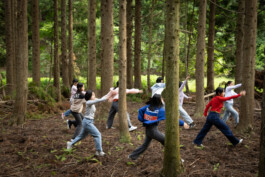
My work navigates between choreography, visual storytelling and filmmaking. I work with the body as a site of memory, knowledge and experience, and with the camera as a way of entering into a relationship with it.
I am drawn to gestures, traces, rhythms and forms of knowledge that move between bodies, generations and places. My work develops through encounters and co-authorship approaches with people whose experiences are shaped by migration, displacement, resilience, injustice and ancestral knowledge.
I work with the camera as a choreographic partner and with editing as a form of composition. A movement, a face, a landscape, a sound or a pause can become a starting point. I am interested in what happens in the space between these fragments, and in what an image can hold without having to explain it.
My recent work has increasingly turned towards questions of perception, presence and the unseen. I look at how images can carry memory, how bodies can become archives, and how film can create a space for forms of knowledge that are difficult to name.
At the centre of my practice is a simple question: how do we look, and how do we allow ourselves to be looked at? This informs what I call a politique du geste, politique du regard, a way of thinking about movement and image as forms of relation.
My work navigates between choreography, visual storytelling and filmmaking. I work with the body as a site of memory, knowledge and experience, and with the camera as a way of entering into a relationship with it.
I am drawn to gestures, traces, rhythms and forms of knowledge that move between bodies, generations and places. My work develops through encounters and co-authorship approaches with people whose experiences are shaped by migration, displacement, resilience, injustice and ancestral knowledge.
I work with the camera as a choreographic partner and with editing as a form of composition. A movement, a face, a landscape, a sound or a pause can become a starting point. I am interested in what happens in the space between these fragments, and in what an image can hold without having to explain it.
My recent work has increasingly turned towards questions of perception, presence and the unseen. I look at how images can carry memory, how bodies can become archives, and how film can create a space for forms of knowledge that are difficult to name.
At the centre of my practice is a simple question: how do we look, and how do we allow ourselves to be looked at? This informs what I call a politique du geste, politique du regard, a way of thinking about movement and image as forms of relation.